
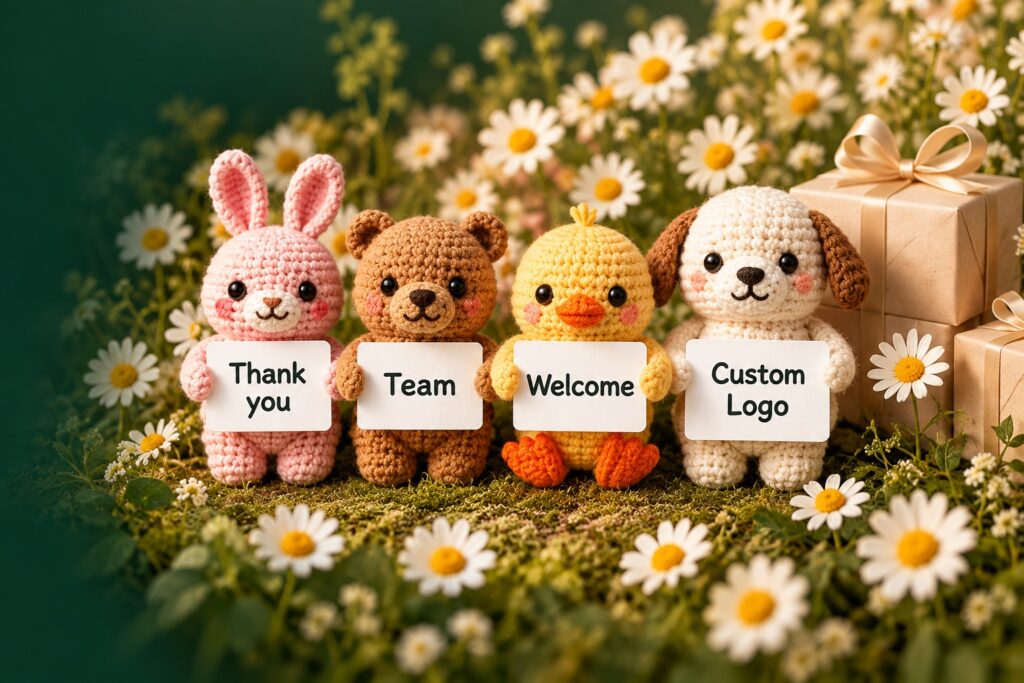
A custom crochet sample is the point where your idea becomes something you can inspect. Before approving bulk production, compare it with the agreed design and record what is accepted, what needs changing and what you have not yet been able to check.
This custom crochet sample approval checklist is for reviewing a proposed new design after sampling. Keep the sample, its photographs and your written comments together so everyone is working from the same version.
1. Identify the exact version under review
Start with the agreed reference, design notes and sample date. If there have been revisions, label the current version clearly, such as “Sample B, reviewed 12 October.” Avoid referring only to “the latest photo,” which becomes ambiguous when another image arrives.
Confirm what the sample represents: the crochet character alone, the character with its card, or the complete packed gift. Record anything still provisional. A placeholder card or demonstration box should not accidentally become an approved production detail.
2. Check the silhouette and measure consistently
Look at the front, back and both sides. Compare the overall proportions with the agreed reference: body shape, head size and the position of ears, arms or other defining features. For a design intended to stand, place the sample on a level surface in its intended display position.
Measure without stretching or compressing the crochet. Write down the method as well as the result: overall height including ears, widest body width and depth from front to back. State whether the card or other projecting details are included. A ruler beside the sample makes your comment easier to understand.
Ask which dimensions will be used for production review and what variation is acceptable. Do not assume an unstated tolerance or expect every handmade detail to match a photograph exactly.
3. Review colors with the viewing conditions in mind
Compare the sample with the agreed color reference. If you have a physical sample, view it in neutral, even light as well as the setting where it will be displayed. Record which part concerns you, such as the body or an accent detail.
Photographs, lighting and screens can make colors appear different. If you are reviewing images only, ask for unfiltered pictures under consistent lighting. When a particular shade is essential, discuss how it will be confirmed before approval rather than judging it from one screen image.
4. Inspect the finish and recognizable details
Examine the visible stitch appearance, joins and transitions between colors. Note loose yarn ends, unexpected gaps, exposed filling or details that appear uneven. Describe the location precisely and include a close-up, rather than writing “the finish needs improving.”
Check the features that give the character its expression: eyes, mouth, ears and accessory positions. Separate an agreed feature from a new preference. Moving the mouth to match the approved reference is a different request from changing the expression after seeing the sample.
5. Read the actual card in its intended position
Compare the card word for word with the approved text file. Check spelling, names, dates, punctuation and capitalization, then examine the finished layout. Are line breaks awkward? Is any text hidden by the character’s hands? Can you read the message at the intended display size without enlarging a photograph?
For approved artwork, inspect its orientation, placement and any cropping. Record whether the sample uses final artwork or a placeholder. If the order includes several card versions, ask which proof represents each version; accepting one card does not review the others.
6. Review the proposed packaging as a complete set
If packaging is part of the sample scope, check the gift inside the proposed pack. Does the card bend or catch when it is inserted? Is the character compressed? Can the pack close as intended? Check the visible arrangement again after unpacking.
For a shipped sample, photograph the outer package and the item on arrival. Distinguish packaging damage from the character’s construction. A successful sample shipment is useful evidence, but it does not establish how every future parcel will arrive. Ask about any packing changes proposed for bulk production.
7. Send one revision record and a clear decision
Combine comments into one numbered list. For each item, state the observed issue, the requested change and the image that shows it. Keep accepted details separate so they are not changed accidentally. Ask which revisions are included and whether changes affect the sample cost or schedule.
Use the record below for each review:
Design / sample version: [Reference and version]
Review date and reviewer: [Details]
Review basis: [Physical sample, photos or both]
Measurements and method: [Results]
Accepted details: [Items]
Requested changes: [Number, location, change and image]
Not yet checked: [Items needing confirmation]
Decision: [Revise and resubmit / approved as identified]
A message such as “approved if you change the face” leaves the final version unresolved. If changes remain, request a revised sample or agreed evidence for another review. When satisfied, identify the accepted version and scope explicitly, and keep that record for later comparison.
Planning an original character? Xyluria’s new-design projects start at 50 pieces. Request a custom project and sample quote to confirm the sampling scope, revision arrangements and next steps.